
Goodbye to Generic SaaS: How AI Drives Truly Useful Solutions for the Customer
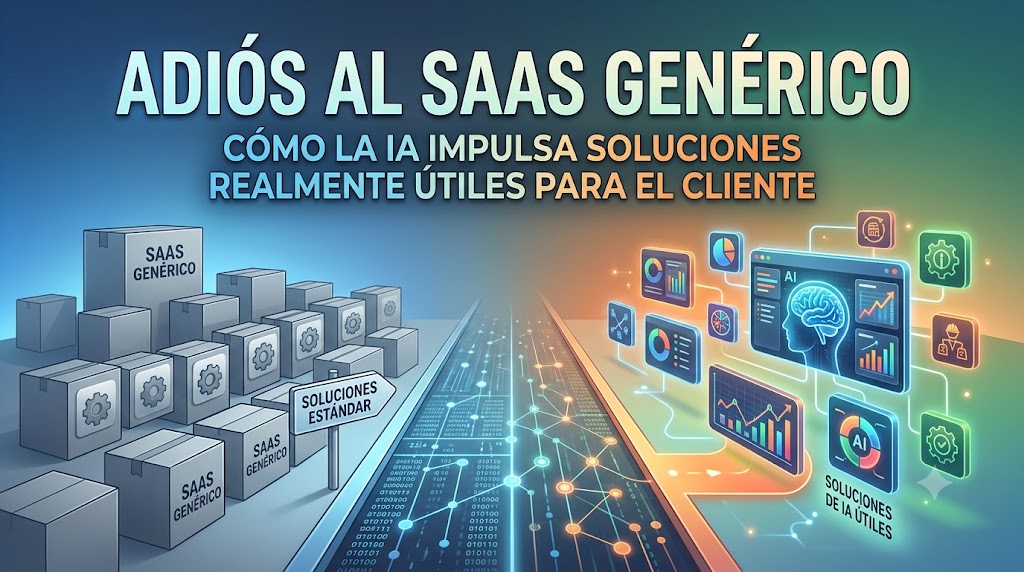
Goodbye to Generic SaaS: How AI Drives Truly Useful Customer Solutions
Over the last decade, the Software as a Service (SaaS) model has radically transformed how companies consume and deliver software. The promise of accessibility, scalability, and constant updates democratized technology, putting advanced tools within reach of small and large organizations. However, as the market matures, a challenge inherent to the SaaS model is becoming increasingly evident: its tendency to offer generic solutions, designed for "many" but optimized for "few."
Today, a new wave of innovation driven by Artificial Intelligence (AI) is not only improving existing SaaS but is paving the way for the development of entirely new solutions distinguished by a fundamental characteristic: their intrinsic usefulness and deep personalization for the end customer.
The Achilles' Heel of Traditional SaaS: Generalization
SaaS success is based on its ability to serve a large user base with a single software version. This brings economic benefits for the provider and rapid adoption for the customer. However, this massification has its drawbacks:
- Feature Bloat: Users often pay for countless features they will never use, complicating the interface and learning curve.
- Lack of Deep Personalization: Although many platforms allow for configurations, they rarely offer a fundamental adaptation to the unique workflows or needs of each business or user.
- "Good Enough" Experience: SaaS solutions are often "good enough" for most, but rarely "perfect" or "indispensable" for a specific, complex use case.
This is where Artificial Intelligence comes in, redefining what it means to be "useful."
The Promise of AI: Creating Real and Personalized Value
Developing AI-powered solutions is not just about automating tasks, but about understanding and anticipating customer needs in a way that traditional software simply cannot. AI enables the creation of solutions that:
- Understand Context and Implicit Needs: Through data analysis, Machine Learning, and natural language processing, AI-powered solutions can learn user behavior patterns, preferences, and even unarticulated challenges. This allows for proactive functionalities and ultra-relevant recommendations.
- Offer Personalization at Scale: Beyond manual configurations, AI dynamically adapts the experience, functions, and results to each individual or business. An AI system not only configures itself but evolves with the user.
- Generate Radical Efficiency: By automating complex tasks, optimizing processes, and making real-time data-driven decisions, AI-powered solutions free up significant time and resources, allowing users to focus on higher-value strategic activities.
- Solve Problems Proactively: Instead of reacting to problems, AI can predict potential issues and offer solutions before they impact the customer. This transforms the user experience from reactive to predictive.
- Provide Actionable Business Intelligence: AI solutions not only display data but provide practical insights and concrete suggestions to improve performance, identify opportunities, or mitigate risks.
Examples of How AI Replaces Generic SaaS with Utility
- From Standard CRM to Intelligent Sales Assistant: A traditional CRM manages contacts and pipelines. An AI-powered solution not only does that but suggests the best time to contact a client, predicts the probability of closing a deal, automatically personalizes email messages, and even trains new salespeople based on success data.
- From Project Management Software to Intelligent Team Coordinator: A project management SaaS organizes tasks. An AI-powered platform, however, optimizes resource allocation based on team workload and skills, predicts delays and proposes adjustments, and identifies bottlenecks before they affect deadlines.
- From Generic Customer Support to Proactive Virtual Agent: SaaS chatbots answer frequently asked questions. An AI-powered solution learns from each interaction, offers personalized resolutions, predicts when a customer might need help, and proactively communicates to prevent problems or improve the experience.
The Future is Extreme Utility
Evolution does not necessarily mean the end of SaaS, but its profound transformation. We are witnessing the birth of a new category of "Solutions as a Service" (AIaaS) where AI is not an additional feature, but the fundamental engine that drives personalization, proactivity, and ultimately, true utility.
Companies that embrace AI development to create solutions that not only solve a problem but do so in a deeply adapted and efficient way, will be the ones to lead the market. For customers, this means finally accessing tools that not only facilitate their work but transform it, offering tangible and measurable value that goes beyond mere functionality.
The era of "good enough" solutions is coming to an end. Artificial Intelligence is here to build a future where every tool is, truly, useful.
Comments
Be the first to comment.