
Develop with AI! Why MPCs are Indispensable in Your Personal Projects Today
Hello everyone!
Have you ever felt that, no matter how much AI advances, there's a barrier when it comes to truly understanding and using what we build? I have, and a lot! Especially in my personal projects, where every minute counts and efficiency is gold. But I have to tell you a secret (or not so secret): I've discovered a way to close that gap, and it's called MPCs. And believe me, nowadays they are indispensable.
What about MPCs?
Now, before you think of complex predictive controllers (nothing of the sort here!), let me clarify what MPCs mean in this context, that of Tucu-ui. For me, and for the ecosystem I'm exploring, an MCP (Modular Component Package) is basically a UI component (or any code module) that not only works but is designed to be understood by Artificial Intelligence. How? Through metadata, schemas, and configurations that give AI a clear map of how to use it, what properties it has, what it does, and how to interact with it. Imagine that each component is not just code, but also its own instruction manual for AI. Cool, right?
Why are MPCs crucial NOW in personal projects?
Why are they so important right now, especially for us independent developers or for our personal projects?
- AI is no longer the future, it's the present: It's everywhere. If our code isn't "AI-friendly," we're missing a huge opportunity to accelerate, optimize, and be more creative.
- Unparalleled efficiency: In personal projects, time is limited. MPCs allow you to delegate repetitive tasks or boilerplate code generation to AI, freeing you up for business logic or pure creativity.
- Consistency and quality: AI, with the right instructions (MPCs!), can generate components with consistency and adherence to standards that sometimes, in a rush, we might overlook.
Your Code, a Universal Language for AI: The Co-pilot of the Future
Here comes the magic: how do we get AI to truly understand our creations? With MPCs. When we define a component with an mcp-schema.json, an mcp-metadata.json, or an mcp-config.json (as in Tucu-ui), we are giving AI a universal language. We tell it: "Hey, this is a button. Take these props, do this, and this is how it looks".
- Goodbye to ambiguity: AI doesn't have to guess. It has the exact specification.
- Precise code generation: Need a new component with certain characteristics? AI, by understanding your MPC, can generate it precisely, adjusting to your styles and patterns.
- Intelligent interaction: Think about this: an AI that not only generates but interacts with your UI. What if an AI assistant could "use" your forms or tables? That's the next level!
The Economy of Tokens: Smart AI, Smart Development
This is a point often underestimated. Language models like GPT work with "tokens." The more precise our instruction, the fewer "ramblings" or failed attempts AI will have to make to give us what we want.
- Greater token efficiency: By giving AI a well-defined MCP, we are giving it the most relevant and structured information. This means AI can reach the solution faster, with fewer tokens consumed.
- Cost reduction: Fewer tokens, lower costs. This is crucial if you are using paid APIs.
- Faster and more relevant responses: AI processes and generates responses more quickly when it has a solid, understandable foundation of our components.
Tucu-ui MCP: My Secret Ally in Frontend
Now, let's talk real life. I've been using Tucu-ui MCP for my frontend projects, and it's been a game-changer!
-
How did I implement it? I started by installing the CLI (
@mcp-server/cli), which allows me to initialize projects and generate the basic structure of my MPCs. Then, I defined my components, but the key was creating thosemcp-schema.jsonandmcp-metadata.jsonfiles for each one. This is where I tell AI everything about my component: itsprops, its type, its description, usage examples. -
My day-to-day looks like this:
- Quick generation: I need a new product card. Instead of writing it by hand, I give AI a
promptusing MCP capabilities, and boom!, I have a base component ready, following my defined styles and patterns. - Consistent components: As my project grows, AI helps me maintain consistency. If I have a
ButtonMCP, I know that any button generated or modified by AI will follow those guidelines. - Live documentation: Schemas and metadata not only serve AI, but they are also incredible documentation for me! It's a single source of truth for understanding my components.
- Integration with AI assistants: I've experimented with integrations that, using MPCs, allow AI assistants not only to understand but to interact with the UI. Imagine asking an assistant: "Create a contact form with 3 fields: name, email, and message, using my
InputandButtoncomponent." And having it do it!
- Quick generation: I need a new product card. Instead of writing it by hand, I give AI a
-
Exploring further: The tools offered by Tucu-ui MCP (you can see more in their links, they are super useful!) give me a solid foundation to take my projects to the next level, especially with the integration of ChatGPT plugins or OpenAI Assistants. Knowing that my components are ready to be consumed by these powerful tools is liberating.
Conclusion: Don't get left behind!
In summary, if you're building personal projects, whether for a hobby, to learn, or to launch your next big idea, don't underestimate the power of MPCs. It's not just about writing code; it's about writing smart code that speaks the language of AI. It's a minimal time investment that translates into a brutal acceleration of your development, an improvement in quality, and, honestly, a lot more fun!
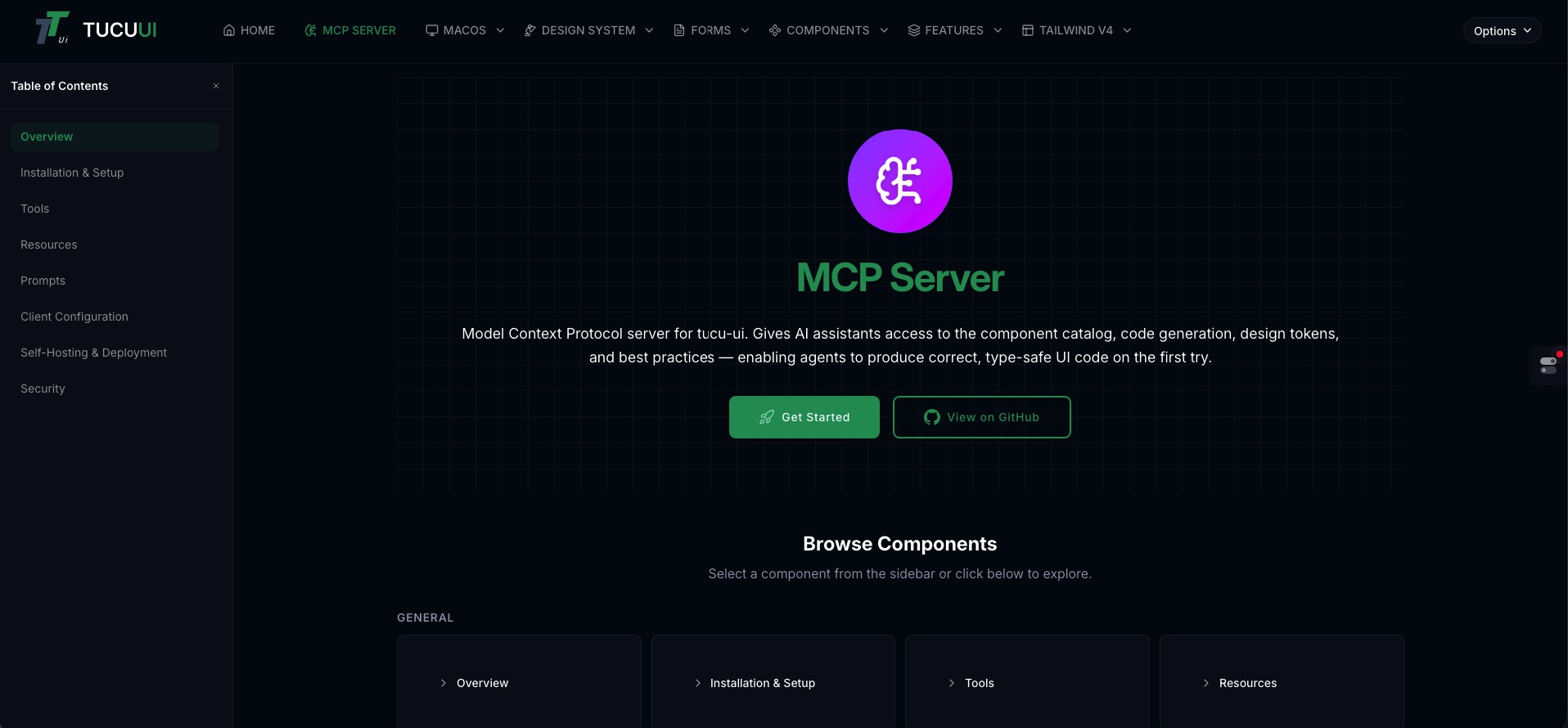
Go ahead and explore how Tucu-ui MCP can help you transform your workflow. The future of development is here, and it's AI-powered! Visit Tucu-ui MCP Overview to get started.
Comments
Be the first to comment.