
The Art of Estimating in the Age of AI: Beyond the Lines of Code
The Art of Estimating in the AI Era: Beyond Lines of Code
Hello everyone! I'm Esteban Burgos, a software solutions architect, and today I want us to talk about something that's on many minds in our industry: project estimations in this fascinating era of Artificial Intelligence.
As we well know, AI has burst onto the scene with unusual force, facilitating code generation and automating tasks that previously consumed hours and hours of human work. This, which at first glance seems like a blessing, has led us to a turning point, a kind of 'friction zone' for both us, the developers, and our clients.
Human Hours or AI Tokens? The Valuation Dilemma
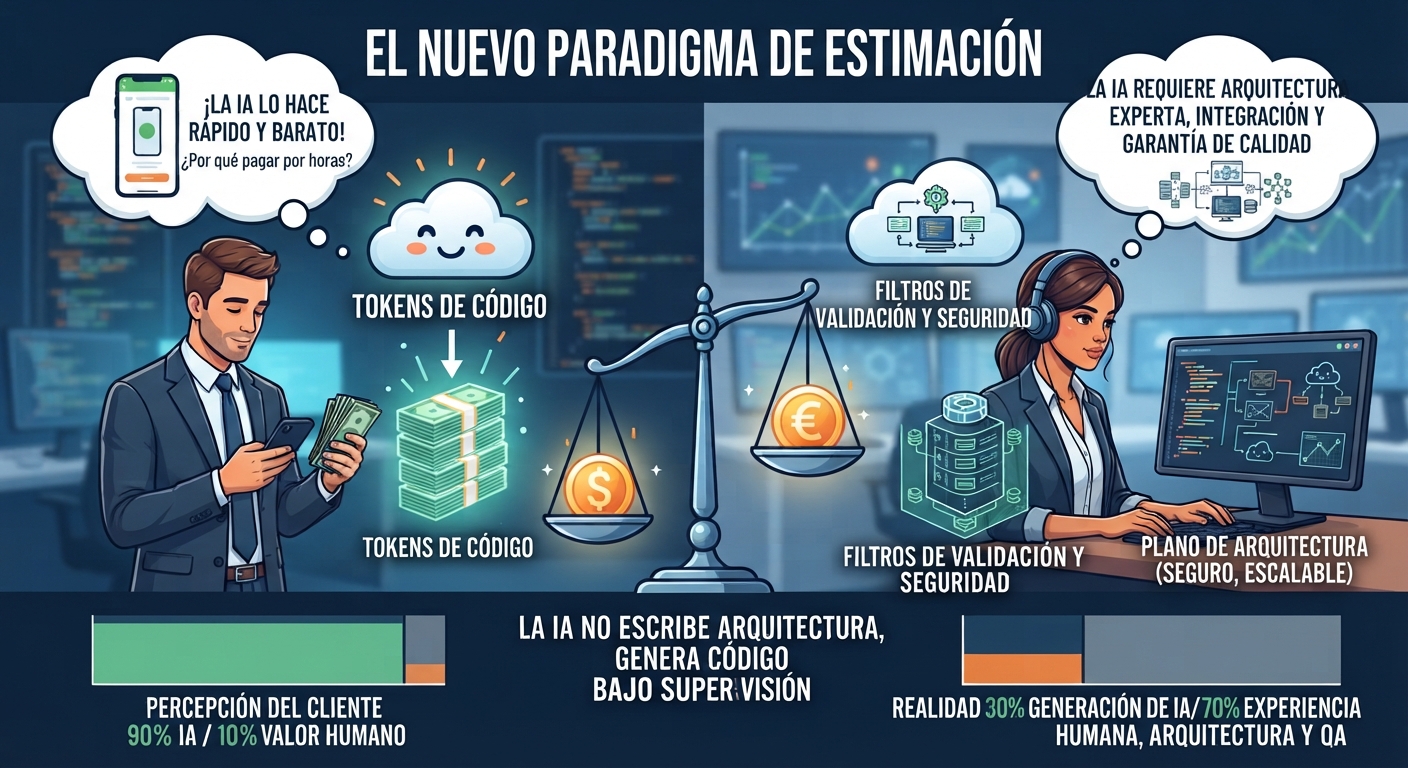
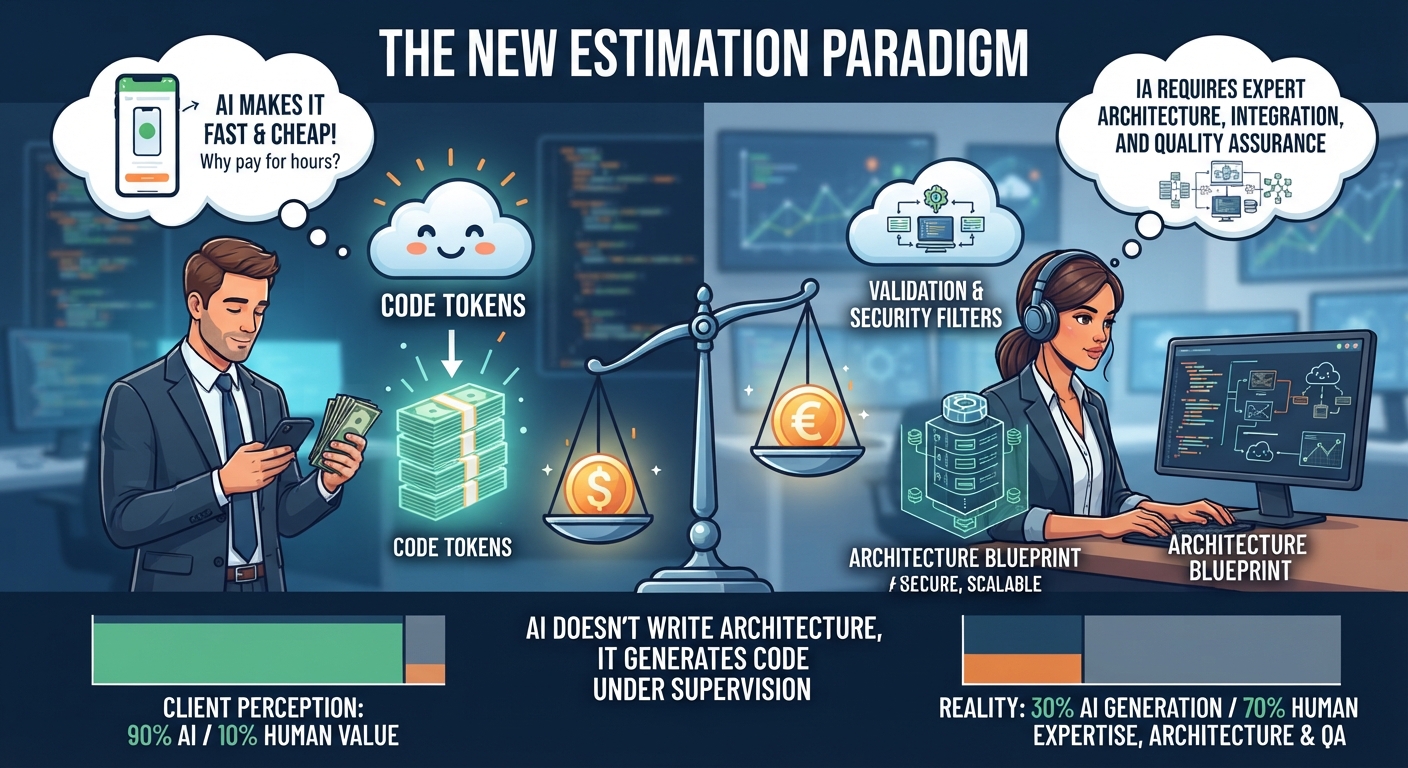
Suddenly, traditional 'man-hours' are being translated into 'AI model tokens,' and this completely changes the perception of value. Let's see why:
The Client's Vision: An App in Minutes?
On one hand, we have our clients. With the promise of AI just around the corner, it's understandable that many think: "If AI can generate code so quickly, why does my project still cost the same or take X amount of time?" They believe that, with a good AI tool, they can generate their own application or that the process should be almost instantaneous and, therefore, much more economical. What is often not considered is all the invisible scaffolding that an expert developer knows is crucial: robust architectures, scalability, security, data management, integration with other systems, and, of course, anticipation of future problems. Technical details that only experience and deep knowledge can foresee and design.
The Developer's Puzzle: How to Value My Expertise?
On the other hand, there are us, the developers. We find ourselves at a crossroads. If a large part of functional code can be generated by AI, how do we charge for our work? Our work is increasingly focused on a deep understanding of functional requirements, the design of resilient architectures, the analysis of business and application complexity, optimization, the resolution of unique problems, and the intelligent integration of these AI tools. We are no longer just 'coders'; we are strategists, architects, and complex problem solvers. Our minds are the true engine, not our hands typing non-stop.
How Should We Approach Quotes Nowadays?
The answer is not simple, but I firmly believe it involves redefining what we truly value and sell. Here I share my perspective as a solutions architect:
-
Sell Value, Not Hours or Lines of Code: Let's forget the metric of 'how many lines of code AI generates' or 'how many hours it took me to type.' What the client truly buys is the solution to a business problem, efficiency, scalability, and the competitive advantage that their application will provide. Our expertise lies in translating their needs into a viable, efficient, and sustainable technical solution. AI is a tool to reach that solution, not the solution itself.
-
Highlight Architecture and Strategic Design: This is where architects like me have a more critical role than ever. AI can write the bricks, but it doesn't build the skyscraper. We design the blueprints, the structure, the foundations. The design of a good architecture, the choice of appropriate technologies, fault prediction, deployment strategy, and security are elements that require critical thinking, experience, and a holistic vision that AI cannot replace (at least, not yet).
-
Complexity Analysis and Risk Management: Before the first line of code (AI-generated or not) is written, there is immense work involved in requirements analysis, identification of key functionalities, integration studies, and, crucially, risk assessment. An experienced developer knows how to identify critical points, dependencies, and potential bottlenecks. This is pure expertise and should be valued.
-
Optimization and Performance: AI can generate code, but is it the most optimal? Is it free of vulnerabilities? Will it scale with demand? The review, optimization, and performance assurance of code, even if generated, remains a high-value human task.
-
Resolution of Unique Problems and the Human Touch: Every business is different, and every problem has its nuances. The ability to understand these particularities, to devise innovative solutions that perfectly adapt to client needs, and to infuse that 'human touch' into the user experience is something that AI cannot replicate. It is the value of creativity and empathy.
A Friendly Conclusion: Collaboration and Mutual Understanding
In this exciting era of Artificial Intelligence, where tools empower us in unimaginable ways, it is fundamental to foster a culture of collaboration and mutual understanding between developers and clients. Developers must educate our clients about the real value of our work, which goes far beyond simply writing code.
And clients, for their part, must understand that, although AI accelerates certain processes, vision, strategy, robust architecture, and the ability to solve complex problems remain the heart of any successful project.
So, the next time we talk about an estimation, let's not just think about lines of code or AI tokens, but about the strategic value, experience, and vision that a team of experts brings to transform an idea into a functional and sustainable solution. AI is an ally, not a replacement for the intelligence and art of estimating and building quality software.
Let's keep building the future, together and intelligently!
Comments
Be the first to comment.