
Tokens in Command: Empowering Agents to Optimize Resources without Sacrificing Quality
Tokens in Command: Empowering Agents to Optimize Resources Without Sacrificing Quality
In the dizzying race of Artificial Intelligence, where every interaction with a large language model (LLM) involves the consumption of “tokens,” efficiency has become a metric as critical as accuracy. How can we ensure that our AI applications not only deliver high-quality results but also manage their resources intelligently? The answer could lie in the agentic system architecture, where agents themselves have the ability to decide how and when to use their tokens, optimizing effort without compromising quality.
The Token Dilemma in the AI Era
Every word, every concept processed by an LLM, translates into a number of tokens. Excessive use of these tokens can result in high operational costs, unnecessary latency, and, paradoxically, a decrease in quality if the model is forced to operate under arbitrary restrictions. On the other hand, a token budget that is too tight for a complex task can lead to superficial or incomplete responses. The challenge lies in finding the perfect balance, allowing each task to receive the appropriate and necessary attention and resources.
Traditionally, token allocation and model selection have fallen to developers, who set static limits. However, the dynamic nature of real-world tasks demands a more flexible and autonomous solution.
Agentic Systems: The Intelligent Solution
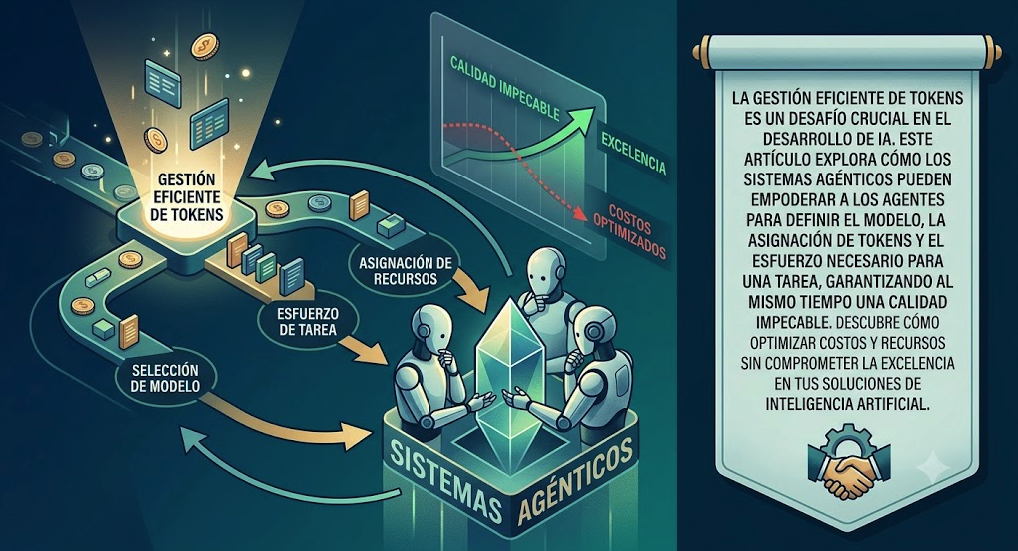
An agentic system represents a paradigm shift. Instead of rigid, centralized control, we empower individual AI agents to be responsible for their own operations. In the context of tokens, this means that an agent, upon receiving a task, not only executes it but also analyzes its complexity, determines the most suitable model, and estimates the amount of effort (and thus, tokens) required to complete it with the expected quality.
How an Agentic System Manages Tokens and Effort
Imagine an AI agent that, before diving into a task, “thinks” about how to approach it. This process could be broken down as follows:
- Task Analysis: The agent evaluates the incoming request. Is it a simple question requiring a direct answer, or is it a complex research task involving multiple steps, deep reasoning, and information synthesis? Complexity is mapped to a “demand level.”
- Dynamic Model Selection: Based on the demand level, the agent selects the most appropriate LLM. For simple tasks, it might opt for a smaller, more economical model. For highly complex tasks or those requiring sophisticated reasoning, it would choose a more powerful model, knowing that this entails higher cost and, possibly, latency. This decision is an intrinsic balance between cost and capability.
- Intelligent Token Allocation: Once the model has been selected and complexity evaluated, the agent assigns a dynamic token budget. Instead of a fixed limit, this budget adapts to the specific task. For an essay writing task, it might self-allocate a generous budget; for a simple classification, a much tighter one.
- Effort Definition: “Effort” is measured not only in tokens but also in the number of iterations, the depth of search, or the level of self-criticism the agent will apply. An agent might decide to perform multiple rounds of refinement or cross-verification for a critical task, while for a routine task, it would settle for a single efficient pass.
- Quality as a Priority: The crucial aspect is that all these decisions are made with the primary goal of maintaining quality. The agent is programmed to understand that saving tokens should not lead to a detriment in the excellence of the final result. If the initial analysis suggests that a task requires a high-end model and a large number of tokens to be excellent, the agent will prioritize quality over marginal savings.
Benefits of an Agentic Approach to Token Management
Implementing this type of agentic system offers significant advantages:
- Cost Optimization: By using the precise model and number of tokens for each task, unnecessary expenses are avoided, resulting in substantial long-term savings.
- Greater Operational Efficiency: Simpler tasks are resolved quickly with lightweight models, freeing up resources for more complex ones and improving overall system performance.
- Consistent and Improved Quality: By allowing agents to dynamically evaluate and allocate resources, complex tasks are ensured to receive the level of attention they deserve, raising the average quality of outputs.
- Scalability: The system can handle a growing volume of tasks of diverse complexity without constant manual reconfiguration.
- Flexibility and Adaptability: Agents can autonomously adapt to new types of tasks or changes in resource demand, making the system more robust.
Implementation Considerations
Implementing such a sophisticated agentic system requires careful engineering. It is fundamental to design:
- Monitoring and Feedback Mechanisms: For agents to learn and improve their resource allocation decisions. If a task resulted in low quality despite the assigned resources, the agent must be able to learn from it.
- Agent Training and Configuration: Agents must be trained to understand task complexity and the capabilities (and costs) of the different models available.
- Cost-Quality Balance Policies: Establish clear guidelines on how agents should prioritize between cost savings and quality assurance, especially in scenarios where both objectives may conflict.
Conclusion: The Future of Resource Management in AI
Token management can no longer be a static and unilateral decision. By empowering our AI agents to be autonomous in task evaluation, model selection, and resource allocation, we are not only optimizing costs and efficiencies. We are building AI systems that are smarter, more adaptable, and fundamentally more capable of delivering high-quality results sustainably. The future of AI lies in the intelligence of its agents, and the correct use of tokens is a key piece in that puzzle.
Comments
Be the first to comment.